Every part of you has a story worth understanding.
You understand the pattern. Now you want something to change.
Many of the people who find me already have a deep understanding of themselves on an intellectual level. They may know where their patterns came from and still feel unable to change what happens inside their body, relationships, or daily life. Some have tried therapy before but are looking for something deeper than another coping strategy or a temporary way to manage stress or symptoms.
A whole-person approach to therapy
I am a licensed therapist who works with kids, teens, and adults navigating complex trauma, attachment and relational wounds, dissociation, eating disorders, PANS/PANDAS, addiction, those living with ALS, and the unique challenges faced by families and caregivers.
I integrate EMDR with Internal Family Systems-based parts work, relational, somatic, psychodynamic, and creative approaches so that therapy can respond to the whole person rather than forcing every experience into one neatly boxed model.
PANS/PANDAS care that recognizes the whole picture
PANS/PANDAS is one of the more specialized areas of my work. It is often misunderstood, and families may spend a long time searching for someone who recognizes that its impact extends far beyond a list of symptoms.
Living with PANS/PANDAS can be disorienting for the person experiencing it and for the people who love them. It can change how a child or teen experiences their thoughts, emotions, body, relationships, eating, sleep, school, and sense of safety. Parents and caregivers may find themselves managing appointments, advocating for their child, living with uncertainty, and trying to hold daily life together while navigating something other people may not understand.
I work with children, teens, and adults living with the ongoing effects of PANS/PANDAS, as well as the parents and caregivers supporting them. Therapy can provide a place to understand what has happened, find language for experiences that may feel impossible to explain, and rebuild regulation, connection, and trust. This work is designed to complement medical care while making room for the emotional and relational impact PANS/PANDAS can have on the entire family.
What it is like to work with me
My style is warm, curious, collaborative, and direct. You do not need to arrive with perfect words, have everything figured out, or perform being okay. I want to understand not only what you are struggling with, but also what your mind and body have been trying to protect. We can approach those patterns with compassion while still being honest about what is keeping you stuck.
Meet Sloan, my therapy guinea pig
Sloan is my guinea pig and a small but important member of my therapy team. She sometimes comes to the office with me and, when a client is interested and comfortable, may join us for part of a session.
Her presence is always optional. For some clients, having a tiny, curious animal nearby can offer grounding, comfort, connection, or a moment of levity when therapy feels especially heavy. Sometimes her presence simply makes the room feel softer and therapy feel a little less intimidating.
Sloan is named after Dr. Mark Sloan from Greys Anatomy, who was played by Eric Dane, who battled ALS, the same disease that my Aunt Kim battled. That connection gives Sloan’s name a meaning far beyond a television show. Much like her namesake, Sloan carries a strong, bold, and quietly confident presence. She is naturally nurturing and often spends her time grooming those around her, an instinctive behavior that reflects the calm, caring energy she brings to the therapy space.
Sloan is known for her affectionate personality and her ability to sit peacefully with people, offering quiet companionship, gentle kisses, and a grounding presence. Her calm demeanor and attentive nature make her a wonderful reminder that comfort, connection, and care can come in very small, and very fluffy packages.
When survival no longer has to make every decision
If you are looking for a therapist who can sit with complexity, recognize the intelligence within your survival strategies, and work alongside you rather than talk at you, we may be a good fit.
Healing does not require you to become less complicated or erase the parts of you that helped you survive. It can mean creating enough safety, understanding, and choice that survival no longer has to make every decision.

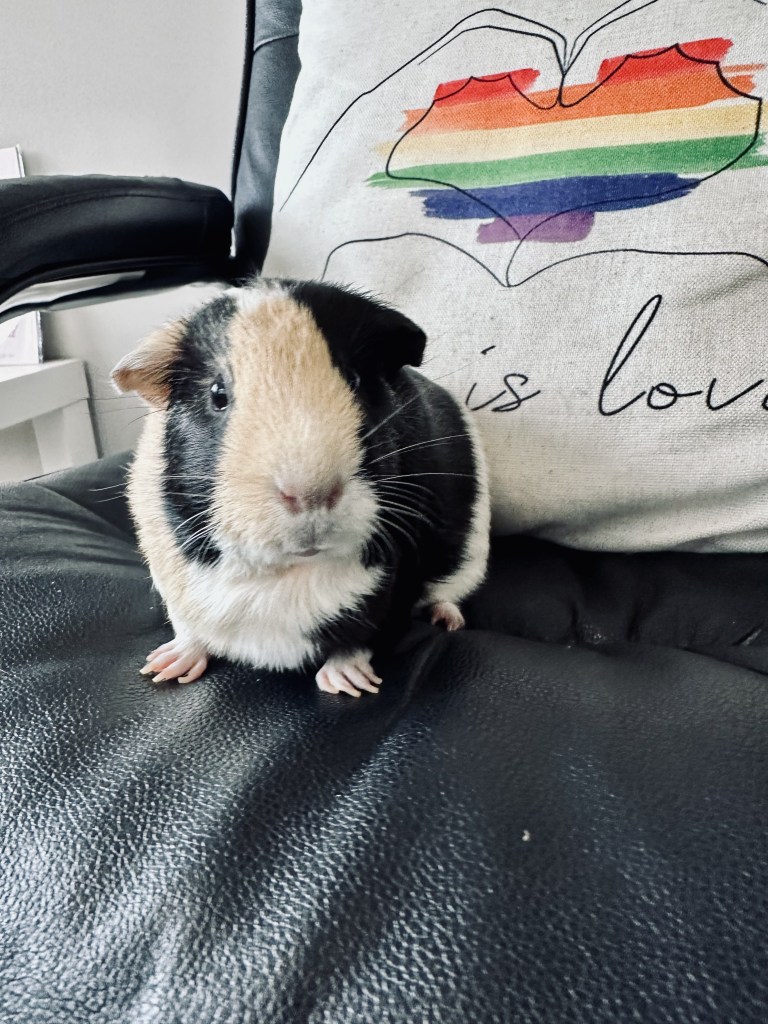
Sloan, “piggie assistant”

